
David Cutler's warning in 2010 (Cutler's 2010 warning)
The Atlantic Monthly's touchdown dance on the 50 yard line (Atlantic Monthly early touchdown dance)
Sunday, November 3, 2013


Sunday, October 27, 2013
Day 27 of the Exchanges
1. The Federal exchanges are a mess. The state exchanges appear to function better but it is not clear whether they are functioning well enough.
3. It is not clear whether the situation is any worse than what was previously experienced with the roll out of Medicare part D in 2006
4. It is not clear who is able to sign up and whether sufficient young healthy people will sign on to make this work. Most of those signing up are signing up for Medicaid.
5. In time we might be able to figure out what all this means.
6. There is much finger pointing to come.Much causality will be claimed and belief will be much more important than actual proof.
Measuring success with sustainability in mind
What constitutes success? It seems like a relatively simple question but it is actually very hard to define success because what appears like a success at one moment in time can end up as an abject failure at a later point in time. The converse is also true. This represents a truism in basically all realms of human endeavors.
Take for example the world of financial investment management. Bernie Madoff was one of the most
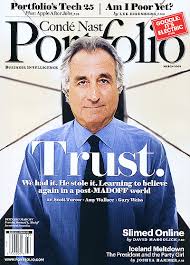 successful money managers of the late 20th century. Even before he was infamous he was famous for his remarkable returns on investments and by all measures was a remarkable success attracting celebrity clients, assuming leadership positions in his industry, and being a darling of the philanthropy community. He was almost universally viewed as a success until he was not. He turned out to be a fraud and a failure because his formula for success was not sustainable. World history has been littered with similar individuals. Just today the WSJ reported on Eike Batista, a Brazilian tycoon whose empire is not collapsing. He was on the Forbes list of most wealthy people in the world as recently as last year. Now he is the center of perhaps the largest bankruptcy ever to occur in Brazil with the prospects of sending destabilizing financial ripples throughout the country and world. The same principle can be applied to institutions, states, and programs.
 When I am driving in my care, I make it a point to take the opportunity to listen to the spectrum of political chatter, listening to both MSNBC and Fox News (as well as NPR). I would argue that MSNBC and Fox news have more in common that they might think and they should each thank their lucky stars that both exist. Each serves to create content for the other. I am struck by the differences in what different ends of the political spectrum view as successes, acceptable failures, and looming catastrophe. Perhaps I am naive (I know that to be the case) but I wish to believe that each side is motivated by the desire to create a better world, but they have very different views on how to go about doing this. Furthermore, each side uses a different set of what amount to be surrogate measures to identify success or failure in a time frame where they can actually measure things. In each case the time frames used by these hedgehogs (always certain and frequently wrong) are likely not entirely useful for avoiding what I refer to as the Bernie Madoff problem;
embracing early what end up being transient and non-sustainable approaches to solve real problems.
 The theme is recurrent; create some program replete with subsidies or tax breaks, spur the development of rapid investment in some particular target area or create or support politically connected entities which are uniquely enriched by politically derived resource flows. The picture may look great, particularly for the select few who derive direct benefits, but what about the broader public? The picture tends to be even more muddled that a simple model of short term success vs. long term failure might imply. What we face is more like a muddled picture in all time frames with bad outcomes always mixed with some good outcomes which are not uniformly distributed. The politically connected will always fight much harder to protect their specific subsidies and rents because they directly benefit. This always happens when the benefits are concentrated and the costs are socialized and not easily measured.
 Each side of the political spectrum cherry picks the respective outcomes to justify whatever they are advocating at the moment, creating implausible causality linkages which conveniently justify their talking points. The latest case is using the government shutdown and making the claim that this resulted in the poor job numbers just released. This is despite the fact the numbers were actually collected before the shutdown. While this particular case highlights a dubious claim of the political left, they have no monopoly on such claims. Reading David Stockman's books made me understand that success in politics going back to at least Nixon has required that one sell such dubious linkages to the public and deploy short term approaches to create transient success at the risk of creating long term failures. It likely goes back much farther (perhaps to the dawn of human civilization). I cannot help but think about Louis XV and his famous utterance about "After me the deluge". Success for him only mattered up until when he was dead.
Sustainability is one of those things which has been seized upon by various parties across the political spectrum. Here again the focus of sustainability anxiety differs across the various political parties. The right worries most about financial sustainability, focusing on deficit spending and the effects upon future financial growth and stability. The left focuses more on environmental issues and sustainability. In each case there are concerns that current practices are not sustainable and if continued they will lead to catastrophes. Who is right? How likely are these various scenarios to come about and in what time frames?
 I must admit I worry more about financial calamities. They have happened with consistent regularity with spectacular financial and social breakdowns punctuating human history. Poverty and social chaos appear to be the default mode for the world. There are many more paths leading there than there are leading to wealth and order. In my limited experience the worst environmental degradation seems to happen where people are the poorest and the path to better environments seems to be through improved generation of wealth. The counter arguments focus on the possibility of existential environmental calamity driven by human action. If this is a "likely" possibility, it should change human behavior. However, we cannot come to an agreement as to what likely means and what threshold should inspire action. Good luck in driving a consensus. The problem is those most passionate about particular concerns function as advocates who have huge blindsides. There appears to be no ability to question their own beliefs and not vilify those with contrary opinions.
It leads us back to asking what is the success that we should aspire to and what cautions should be deploy on our way to those successes? It seems that all of us carry our own unique fears regarding what terrible events might unfold in our futures and we come to these conclusions using primarily emotional decision making tools. Based upon the work of Jonathan Haidt, it seems that these belief systems may be hard wired to some degree. The ends of the political spectrum hold certain things in common, most notably their certainty of being right and having short memories of when they were wrong.
Take for example the world of financial investment management. Bernie Madoff was one of the most
embracing early what end up being transient and non-sustainable approaches to solve real problems.
Sustainability is one of those things which has been seized upon by various parties across the political spectrum. Here again the focus of sustainability anxiety differs across the various political parties. The right worries most about financial sustainability, focusing on deficit spending and the effects upon future financial growth and stability. The left focuses more on environmental issues and sustainability. In each case there are concerns that current practices are not sustainable and if continued they will lead to catastrophes. Who is right? How likely are these various scenarios to come about and in what time frames?
It leads us back to asking what is the success that we should aspire to and what cautions should be deploy on our way to those successes? It seems that all of us carry our own unique fears regarding what terrible events might unfold in our futures and we come to these conclusions using primarily emotional decision making tools. Based upon the work of Jonathan Haidt, it seems that these belief systems may be hard wired to some degree. The ends of the political spectrum hold certain things in common, most notably their certainty of being right and having short memories of when they were wrong.
Sunday, October 13, 2013
Day 13 of the Exchanges
 The enrollments apparently are now a trickle. The launch of the exchanges is now recognized as a "soft" launch. As expected, the state managed exchanges are performing marginally better than the federally run exchange Exchange data. None of this is really surprising with the exception of the California data. They spent about $1 billion of Federal grant money to set up their exchange and they have enrolled no one? The Feds did not get their specs to the programmers until late this spring and there was no way this was going to get launched without serious bugs by the October 1 deadline. Given the other delays, the politics of this program where going to drive a launch by the October 1 deadline, come hell or high water.
My state elected to allow the Feds to run their exchange. Now that people have been able to get access to the sites and see t he offerings, we are now getting a feel for what the insurance offerings and the networks look like. Similar to what has been observed in other states, the exchange here has offerings from a variety of insurers offering what appears to be much thinner networks than their usual products. For example, a number of the major health systems are not part of the Blue Cross and Blue Shield exchange offering. One thing I also did not realize is that those purchasing insurance through the exchange will get a tax break while those buying products outside of the exchange will not.
I am sure that this will evolve over time and hopefully the most robust delivery systems will be able to put in place systems which can identify where expertise and capacity are needed. However, perhaps not. One business model may highlight strategic incompetence with very low rates to attract the well and frugal. I could imagine being able to deploy a network at very low cost if a system did not have to deal with any actual illness.
There are going to be some gaping holes and some scary patient stories. However, there are gaping holes and scary patient stories now. It will be difficult to see if the holes will be bigger and the stories worse for a while. As they say, this is the fog of war....
Saturday, October 5, 2013
Knights, Knaves, and Pawns
In his 1995 article in the Journal of Social Policy, LeGrand addressed addressed issues that are important broadly for understanding the implications of social policy, especially the modern welfare state.
"To what extent are they a response to the perceived failures in the old systems? If they are a response to these failures, are they a good response? .....More specifically, I argue that both the quasi-market and legal changes in welfare systems are based on a particular view of human motivation and behaviour, and that this view is rather different from the assumptions concerning motivation that underlay older models of welfare systems. However, neither this ‘new’ view nor the ‘older’ assumptions are likely to provide an adequate account of the way in which people actually behave in welfare-relevant situations; hence welfare systems based solely on one or the other are likely to fail. What is needed are ‘robust’ welfare policies: ones that allow for the possibility of different kinds of human motivation and hence have the potential for more successful outcomes. This is a broad canvas. Inevitably in places the argument is speculative; equally inevitably it will involve both the caricaturing of distinguished thinkers’ arguments and the over-simplification of a complex reality."
In the private realm, individuals and groups that make bad assessments regarding whether they are dealing with knights or knaves tend to do poorly over the long term. The rest of us can perhaps learn from their mistakes. In the public realm, politics pushes us toward "all in", one size fits all policies, driven often by slim political majorities. The time frames to assess success or failure often is beyond the ability of players to make key linkages. Success in the political realm may be defined by growth of programs and concentration of money and power. It rapidly gets very hard to figure out who are the knights and knaves.
We are not alone in being in a position of lost trust. What I find odd is when specific professionals lose the public trust, the response tends to be to recreate powerful regulatory structures within the realm of politics. What makes us believe that those who gravitate toward political institutions are any more knightly or accountable? Can the problems associated with the complexities of human behavior by fixed best with political tools? I doubt it.
LeGrand's work was applied to the medical realm, describing the evolving perspective of physicians (Are docs KKP).
"Le Grand’s work on post–World War II British social policy found that perceptions of human motivations gradually transformed, with the prevailing view of the typical British citizen morphing from knight into knave as the costs of maintaining an expensive welfare state increased. US perspectives on physicians have undergone a similar transformation with the increasing cost (both to taxpayers and to individual patients) of health care delivery. As physician behavior has been tied to these rising costs and increasing scrutiny has been applied to the quality of care delivered, policy discourse often reflects the perspective that physicians are an obstacle not an enabler to a functioning health care system. Rather than being counted on to exercise their professional ethic to address problems in health care delivery, physicians should be guided to do what is right with an increasing menu of incentive payments (ie, pay for performance or value-based purchasing) or strict regulations. Rather than being counted on to maintain their knowledge and expertise on their own accord, they are subject to periodic examinations to demonstrate continued proficiency. "We now appear to be in a world where physicians are no longer perceived to behave like knights. Some of this altered perception may be justified by less than honorable behavior of of knave like elements within the physician population. I would also venture that certain social programs implemented over the past 60 years have served to undermine physician professionalism, spawning gaming behavior in initially the few and more broadly over time.
We are not alone in being in a position of lost trust. What I find odd is when specific professionals lose the public trust, the response tends to be to recreate powerful regulatory structures within the realm of politics. What makes us believe that those who gravitate toward political institutions are any more knightly or accountable? Can the problems associated with the complexities of human behavior by fixed best with political tools? I doubt it.
Wednesday, October 2, 2013
Day 2 of the Exchanges
As costs become transferred to the public, I see decreased demand and steady downward pricing pressure. Like all predictions, I could be wrong. Only time will tell.
Sunday, September 15, 2013
You can't afford your doctor - transparent accounting
The math is unambiguous. You cannot afford your doctor. However, the injection of third party payment into health care delivery has obscured this reality. Let's take a simple drill down into basic health care finance in terms of ambulatory care. Let us assume that your very average primary care physician makes roughly $200,000/yr. That works our approximately to about $4000/wk, assuming working around 50 weeks a year (which is a generous assumption). Assuming that the average physician works 8 clinical sessions per week which allows for time to do other essential functions (calls, note completion, test follow up), this means that the average physician needs to net $500 per session after all overhead costs.

To make the math simple, let us assume a 66% overhead which would require about $1500 in revenue per clinical session. Let us assume that each of the sessions is scheduled for 6 hours which translates to 8 hours of clinical work. If one is living off the E&M codes, the most common code used in the 99213 code with the 99214 code catching up. One can assume that the average payment will be between the two. I think we can liberally assume a revenue of about $100/patient. That means you need to schedule 15 patients per half day session to make the $1500 to pay yourself and cover your overhead. That means you need to see about 4 patients per hour. That translates to a total of 15 minutes per patient and perhaps if you are lucky you can spend half of that time in actual face to face time with your patient. This boils down to 7.5 minutes face time.
 How many doctor's offices are up front with you when you make the appointment. "You have 7.5 minutes to complete all business. Please be prepared with an appropriate agenda which can fit into 7.5 minutes." Do you want to spend more time and are you willing to pay more for your time? Sorry, not allowed according to the contractual arrangements in place. You don't pay the bills so you don't make the rules.
So you say that your insurance pays for your visits. No they don't. They just take your money and pass it on taking a generous cut. The math of reality is shown above. Through your insurer this is what you purchase. It may be said that cross subsidies should offset such a payment plan. Talk about lack of transparency. Why should we advocate for overpaying for something in order to offset for stinting on another. Furthermore, those closest to the game and having the most at stake quickly figure out how to game the system, providing only over compensated services.
The public needs to understand what they have bought into. When you get sick hope that the 7.5 minutes is enough.
Subscribe to:
Posts (Atom)